PYTHON _ DATA TYPES AND BASIC SYNTAX
By the end of this lesson, the student should be familiar with some of the various data types in python. We would also be looking at the syntax for basic functions.

Hi.
Today, we should be looking at python data types.
In python, the basic data types are:
1. Numeric data types: int, float, complex
2. String data types: str
3. Sequence types: list, tuple, range
4. Binary types: bytes, bytearray, memoryview
5. Mapping data type: dict
6. Boolean type: bool
7. Set data types: set, frozenset
We shall focus on 1 & 2. The others might come up in an advanced class
NUMERIC DATA TYPES
int: Integer - whole numbers
float: Float - decimals, and is accurate up to 15 decimal places
complex: Complex - holds complex numbers
STRING DATA TYPES
str: String - a sequence of characters, maybe alphabets or numbers. Its usually enclosed in " "
BASIC SYNTAX
To display output we use the print command
print("Hello, World")
Sometimes, the data we want to display is stored in a variable. So we omit the quotation marks.
print(variable_name)
Remember that variable names are case sensitive. So Variable_name is not the same as variable_name. The difference is the capital letter V
Here are some rules for Python identifiers ?
1. Python Class names start with an uppercase letter. All other identifiers start with a lowercase letter.
2. Starting an identifier with a single leading underscore indicates that the identifier is private identifier.
3. Starting an identifier with two leading underscores indicates a strongly private identifier.
4. If the identifier also ends with two trailing underscores, the identifier is a language-defined special name.
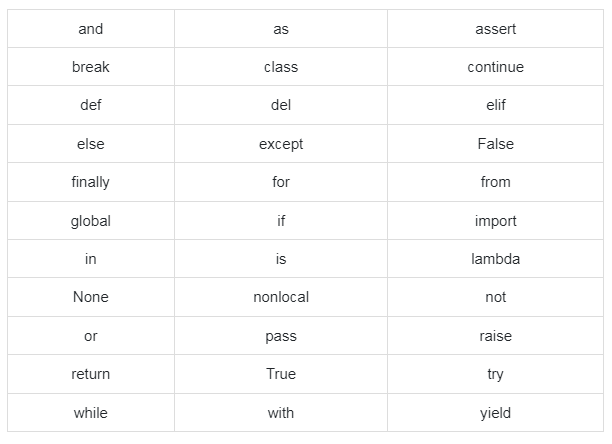
Just like in virtually every programming language, python has reserved keywords - words that cannot be used as identifiers. This is because the words mean something else, and has a different function.
Here is a list of some of them: